How accurate was last year's IP budget?
When we ask IP owners this question, the most frequent response is, “Not very accurate.”
There are many reasons for this, but a fundamental reason organizations struggle with IP budgeting is that few tools or frameworks exist to develop a comprehensive IP budget.
This is ironic given the number of IP cost estimators, IP Management systems, and eBilling products that IP owners can access.
These solutions can help, but each has crucial gaps that limit them to a supporting role. Some just forecast annuity costs, some don’t support all types of IP, others don’t support budget management and reconciliation, and others only work from historical data.
This forces IP owners to stitch together a ragtag collection of unconnected tools to try to (hopefully) estimate all of the costs required for a budget. Spoiler alert: It seldom works well. When it does work, it’s usually only through substantial manual effort.
This isn’t just a tool problem. The industry also needs an approach and vocabulary for budgeting that helps IP owners better navigate the complexities inherent in the process.
This article introduces the Prokurio IP budgeting framework, the model underlying all our budgeting solutions. Whether you use our products or other solutions or do everything manually, this framework should provide the blueprint for building a successful IP budget!
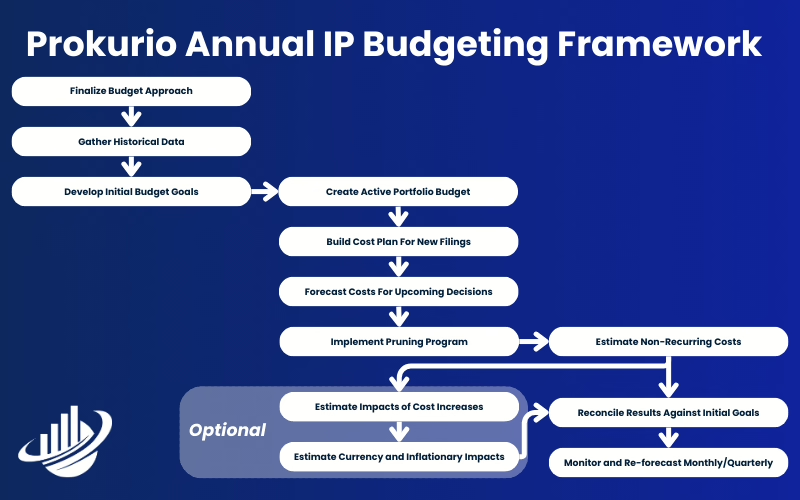
Start with the knowns

An IP budget has to maintain an organization’s existing rights while funding applications in progress. It also needs to cover as-yet-unfiled applications for projects that may not yet exist.
Throw in unpredictable litigation costs and alignment with the realities of how well the overall business is performing, and things get complicated quickly. This also explains why some organizations don’t try.
It can be easy to get lost (or overwhelmed) by all the data points, different systems, and inputs needed to build a budget. So, if you’re frustrated with your IP budgets, we recommend starting from the beginning to ensure you have the right approach.
Wait, there are multiple approaches?
Yes! There are several approaches to building an IP budget, each with pros and cons. Let’s examine three common budgeting approaches and see which is right for you!
Next Up - the assumptions

In top-down budgeting, senior management sets overall financial goals based on historical data, anticipated business activity, and company performance and then allocates a budget to the IP department. This method is efficient and quicker to implement; however, it can lack granularity and frequently overlooks the real costs associated with building and maintaining a growing portfolio. Furthermore, historical IP spending isn’t always a good barometer of future costs.
This approach works well for organizations:
- With minimal or no annual portfolio growth
- That lack the tools, data, or expertise to predict costs
- Who don’t worry about IP costs (yes, they still exist)
This approach works less well for organizations:
- With fast-growing portfolios with significant filing activity
- With large, complex international portfolios
- That reconcile monthly or quarterly actuals to budget
The Final pieces of the IP Budget

Bottom-up budgeting begins lower in the organization, with the IP group utilizing historical spending, portfolio data, and input from business partners to estimate and plan costs and then aggregate these estimates into a budget.
This budget is then aggregated with other budgets from the business to create an overall budget. Since this method is based on the portfolio and involves those closest to the day-to-day activities, it tends to be more accurate and reflective of actual operational needs. However, it can be time-consuming and may result in a budget request significantly out of alignment with leadership expectations.
This approach works well for organizations:
- With high levels of portfolio growth
- That have adequate tools and resources
- Looking for granular budget data and regular reconciliation
This approach works less well for organizations:
- With limited resources and tools
- Who are unable or unwilling to commit the time to properly analyze costs
- With basic budgeting and reconciliation needs
THE HYBRID APPROACH to ip budgeting

We recommend that IP groups use a hybrid approach when building an IP budget. This approach combines elements of both strategies to balance efficiency with accuracy.
Some Top-Down: Senior management sets overall financial goals, limits, and strategic priorities with this approach. They provide broad guidelines or budgetary constraints that help align department-level budgets with the company’s overall financial objectives. This ensures that the budgeting process starts with a clear direction, allowing the organization to maintain control over major financial targets.
Some Bottom-Up: Once the high-level goals are set, the IP group creates a detailed budget based on their IP portfolio, operational costs, and planned projects. Since the people closest to the day-to-day operations better understand the exact costs and resources needed, this process tends to produce more accurate and realistic estimates.
Reconciliation: The inputs from the top-down and bottom-up approaches are reconciled in a negotiation phase. Senior management reviews the departmental budgets, ensuring they align with company-wide goals. At the same time, the IP group provides feedback or adjustments to the initial top-down limits (“You realize what will happen if we stop paying maintenance fees?”). This negotiation helps ensure that both macro-level objectives and micro-level realities are considered in the final budget.
Approval and Implementation: After reconciling the budgets, the final budget is approved, balancing strategic goals and operational needs.
Why we like this approach: This approach provides a target for the IP team to aim towards while also delivering a reality-based budget based on the complexities of the portfolio and the business’s plans.
The reconciliation process ensures that the IP group has the appropriate budgetary scrutiny and alignment across the organization.
Lastly, by building a budget from the ground up, the IP team can reconcile actual spending to budget throughout the year, enabling them to learn and improve their accuracy in future years.
OUR SHAMELESS PLUG
The Planning Part doesn't have to be so hard

One of the challenges with the bottom-up or hybrid approach is the need to quickly create plans and reconcile them against historical spending and budget targets.
We’ve designed Strategic Planner to make this easy, eliminating the spreadsheets and tools you currently need and reducing the time to produce budgets from weeks to minutes.
Click here to learn more about Strategic Planner.