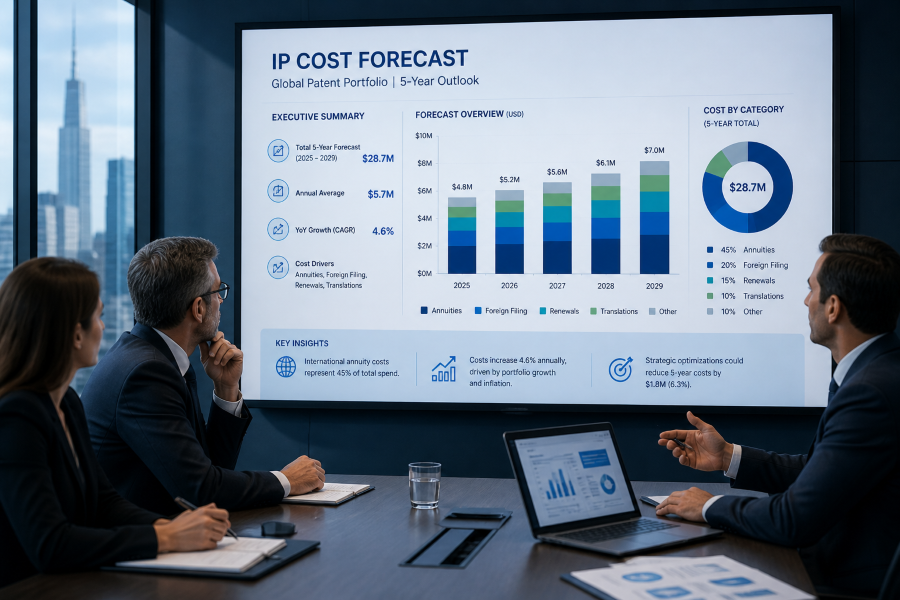
Forecasting gets talked about a lot, here is what it looks like.
IP cost forecasting sounds straightforward until you’re the one who has to produce the numbers. The data is spread across patent offices, foreign associates, prosecution files, and last year’s invoices. The portfolio keeps changing. And the person asking for the forecast needed it yesterday.
Here are three situations IP teams run into regularly and how having the right forecasting tools changes the outcome.
Scenario 1: The Board Wants a 5-Year IP Cost Projection

It starts with a message from the CFO’s office: legal needs to present IP costs as part of the long-range financial plan. Five years out, broken down by year, with assumptions documented by the end of next week.
For an IP team without a forecasting system, this is a painful exercise. You’re pulling patent lists from one place, official fee schedules from another, renewal dates from a third, and trying to stitch it all together in a spreadsheet that breaks the moment the portfolio changes.
With a proper forecasting tool, the portfolio data is already in the system. You select your time horizon, confirm your filing assumptions, and generate the projection. The output shows costs by year, by jurisdiction, by asset type, with the methodology transparent enough to answer questions in the room.
The difference isn’t just time saved. It’s being able to answer the follow up questions: What happens to that number if we file 20% more in Europe? What if renewal fees in China increase next year? A scenario-based forecast turns a static number into a conversation you can actually have.
Scenario 2: A New Product Launch Needs a Filing Budget Before Anyone Will Commit

A product team is preparing to launch in 12 new markets. Legal needs to tell them what it’ll cost to protect the IP in those jurisdictions before the business case gets approved. The ask comes in two weeks before the budget deadline.
The challenge: the cost of filing and maintaining patents in 12 jurisdictions across APAC, EMEA, and Latin America isn’t something most IP teams have memorized. Official fees change. Agent fees vary by country and by firm. Translation requirements add costs that are easy to forget.
A global IP cost estimator lets you model this quickly. Input the jurisdictions, the patent specifications, the expected prosecution path, and get a cost projection that covers filing, prosecution, and maintenance over the patent life. You can run multiple scenarios, filing in all 12 markets versus a prioritized subset, and present the comparison to the business team with enough detail to be credible.
The result is a budget the product team can actually use, produced in hours rather than days.
Scenario 3: The IP Budget Just Got Cut 15%
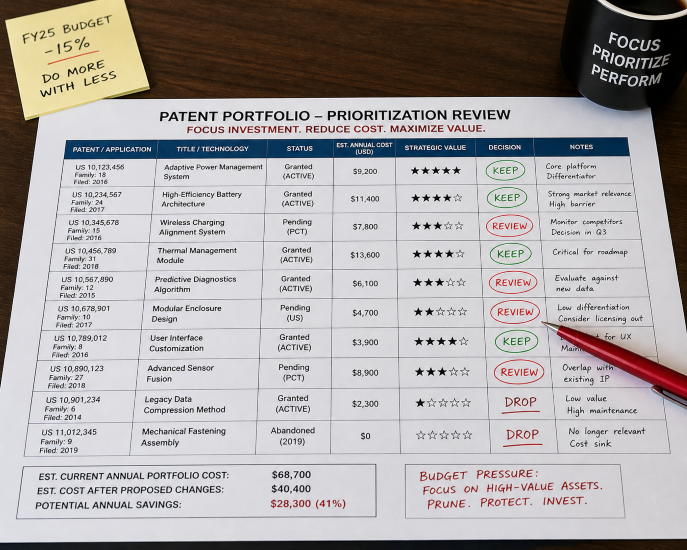
It happens every few years. Legal’s budget gets cut, and IP is expected to absorb a share of it. The question becomes: where do you find the savings without abandoning something you’ll regret losing?
Without a systematic approach, portfolio pruning tends to go one of two ways: either you cut the easiest things (small, old, low maintenance) or you don’t cut anything at all because the risk of making the wrong call feels too high.
A pruning planner changes the dynamic. You start with your maintenance cost projections, set a savings target, and test different pruning policies against your portfolio. Which assets are approaching the end of their commercial relevance? Which jurisdictions are costing more in maintenance than the protection is worth? Where are there duplicate assets covering the same ground?
The tool doesn’t make the decisions for you. But it shows you what different scenarios cost and save, so when you bring a recommendation to your manager or your general counsel, you have the data to support it rather than just instinct.
What These Scenarios Have in Common?
In each case, the underlying problem is the same: IP costs are hard to see clearly, hard to project accurately, and hard to explain to people outside the IP function.
Forecasting tools don’t solve the complexity. They make the complexity manageable so the IP team can spend less time building spreadsheets and more time answering the questions that actually matter.
If any of these scenarios sound familiar, it’s worth looking at what your current process requires versus what it could look like.
Like this kind of stuff?
Explore IP cost planning for owners: Create IP Budgets
Want to learn more about our IP budget planning tools?
Learn more here: IP Budgeting Tools