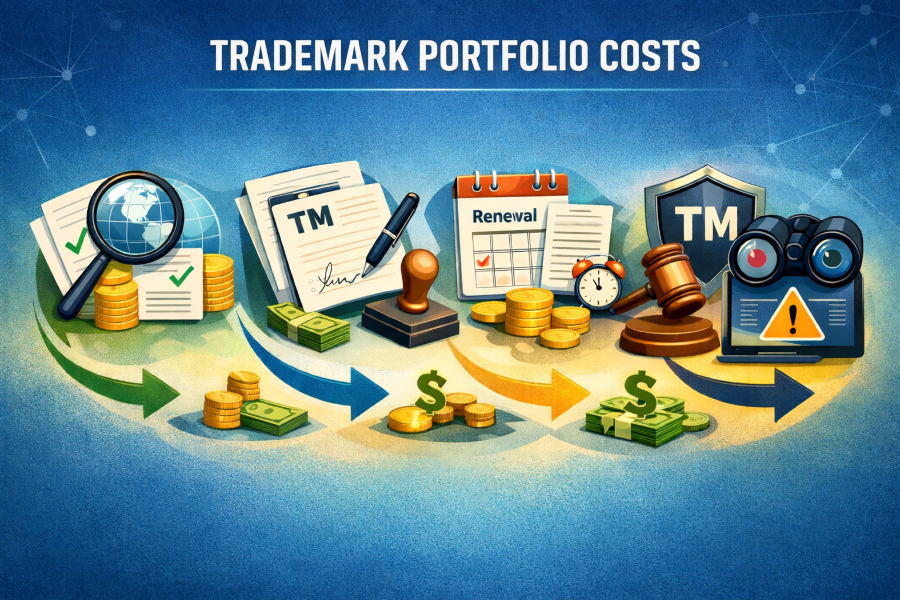
Trademarks are often treated as the quieter line item in an IP budget. Individual trademark costs are generally lower and more predictable than patents, but that predictability can create a false sense of security. Portfolios expand gradually, and for brand-driven organizations, the cumulative cost of maintaining, renewing, and defending trademarks worldwide can match or even surpass patent expenditure.
Effective cost forecasting starts with understanding the full lifecycle of trademark expenses.
Phase One: Clearance and Filing
Before a trademark application is filed, most organizations invest in clearance searches to assess the risk of conflicts with existing marks. A comprehensive search, covering federal registrations, state registrations, common law uses, and domain names, typically runs between $1,000 and $3,000 per mark, depending on scope and jurisdiction.
Filing fees vary significantly by country. In the U.S., a single-class TEAS Standard application currently costs a few hundred dollars in government fees (check the USPTO’s current fee schedule, as these change periodically). But most brands file across multiple classes, and international filings add up quickly. Filing a mark in ten countries across two or three classes can easily cost $15,000 to $30,000 in government fees and local counsel charges alone.
For forecasting purposes, the key variable at this stage is filing volume. How many new marks does your organization expect to file in the coming year? And in how many jurisdictions? Even rough estimates of these numbers dramatically improve forecast accuracy over flat-line budgeting.
Phase Two: Prosecution and Registration
Trademark prosecution tends to be more straightforward than patent prosecution, but it’s not without cost variability. Office actions often related to likelihood of confusion, descriptiveness, or specimen issues require attorney time to address. In the U.S., responding to an office action typically costs $500 to $2,000, but contested matters can escalate costs.
Opposition proceedings are a bigger wildcard. When a third party opposes your application (or when you need to oppose someone else’s), legal costs can escalate to $25,000 or more for a contested proceeding. These events are relatively uncommon on a per-mark basis but can have an outsized impact on a given year’s budget.
The forecasting challenge here is that oppositions are hard to predict for any individual mark, but historical rates can help estimate portfolio-level exposure.
If your organization has historically faced opposition on 5% of filings, that rate becomes a reasonable input for your forecast model.

Phase Three: Maintenance and Renewal
This is where trademark costs become most predictable, and most commonly underestimated through simple oversight. In the U.S., maintenance filings are required between the fifth and sixth year after registration (Section 8 declarations), and renewals are due every ten years. Each of these has associated government fees and attorney costs.
The challenge for large portfolios is volume. An organization with 500 U.S. registrations will have dozens of maintenance and renewal deadlines every year, each requiring review, filing, and payment. Across international jurisdictions, renewal schedules and requirements vary, adding complexity.
The good news is that these deadlines are entirely predictable. You know exactly when each mark was registered and can calculate every future renewal date. This makes maintenance costs one of the most forecastable components of an IP budget, provided you have the data organized to do it.
Phase Four: Enforcement and Watching
Brand owners who don’t actively monitor and enforce their trademarks risk losing rights. Watching services that alert you to potentially conflicting new filings carry ongoing subscription costs. And when conflicts are identified, cease and desist letters, negotiations, and potential litigation all carry costs that are difficult to forecast but important to budget for.
Many organizations address enforcement costs through a reserve or contingency budget rather than trying to forecast specific matters. The size of that reserve should be informed by historical enforcement activity and the competitive landscape in your industry.

Bringing It All Together
The key insight for trademark cost forecasting is that most costs are forecastable if you have the right data: your current portfolio size, your anticipated filing volume, and your renewal schedule. The unpredictable costs, oppositions, and enforcement actions are best handled through historical rate analysis and contingency reserves.
The organizations that forecast trademark costs well are the ones that treat their portfolio data as a planning tool, not just an administrative record.
Next up: we step back from patents and trademarks individually to look at the five key variables that make or break any IP cost forecast.