
FX Is One of the Biggest IP Cost Drivers Nobody Talks About
If you manage an international patent portfolio, you’re paying annuities in dozens of currencies. Most IP teams know roughly what their official fees are. Very few know what they’re actually paying for currency conversion or whether those rates are reasonable.
That’s not an accident. It’s a visibility problem. And it’s costing more than most organizations realize.
How Currency Markup Actually Works
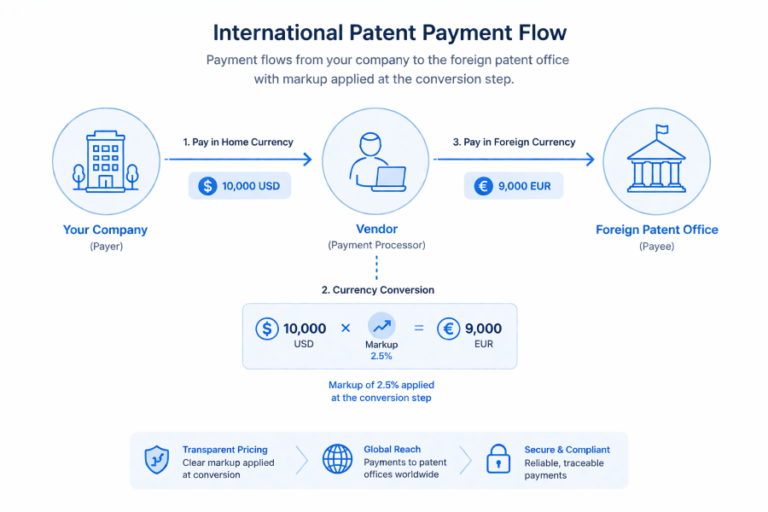
When you pay a patent annuity in Japan, Germany, or Brazil, your vendor converts your home currency into the local currency. The rate they apply is almost never the interbank rate you would see on Google.
The difference between that interbank rate and what your vendor actually charges is the currency markup. Some vendors disclose it. Many don’t. And in most annuity invoices, the FX cost either doesn’t appear as a separate line item at all or gets folded into the agent fee where it becomes impossible to verify.
A markup of 3 to 5 percent sounds small. Applied across hundreds of payments in currencies like the Japanese yen, Chinese yuan, Korean won, or Brazilian real, currencies that can swing significantly, the total adds up fast.
How Much Does It Actually Cost?
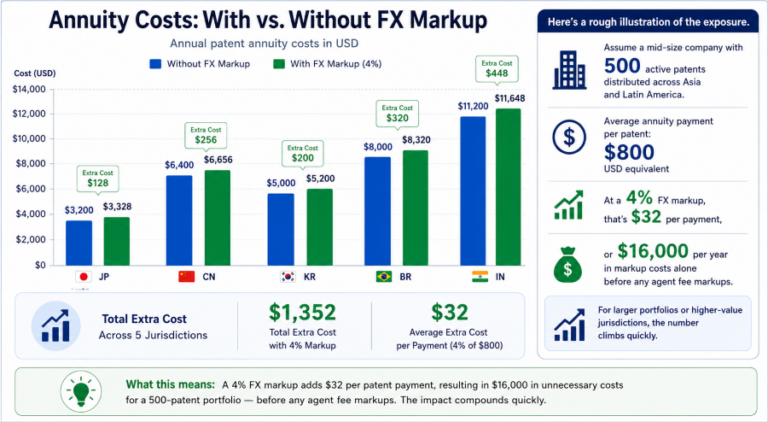
Here’s a rough illustration of the exposure. Assume a mid-size company with 500 active patents distributed across Asia and Latin America. Average annuity payment per patent: $800 USD equivalent.
At a 4% FX markup, that’s $32 per payment, or $16,000 per year in markup costs alone before any agent fee markups. For larger portfolios or higher-value jurisdictions, the number climbs quickly.
The challenge is that without a transparent invoice, you can’t verify whether this is happening or quantify what it’s costing you. Most organizations are paying for it without knowing.
The Three Contract Clauses That Protect You

You can’t eliminate currency costs, but you can control them. These three terms belong in every annuity vendor contract:
1. A Currency Cap — Limits how much above the interbank rate your vendor can charge for conversion. 3–5% is a reasonable negotiating position. Without a cap, there’s no ceiling on what they can apply.
2. A Specified Conversion Date — Defines exactly when the rate is locked in. “Invoice date” and “payment date” can be weeks apart and the rate can move significantly in between. Your contract should name one and stick to it.
3. An Agreed FX Reference Source — Specifies which published rate is used as the baseline. Common references include Reuters, Bloomberg, or the European Central Bank’s daily rate. Without this, your vendor can apply whatever source produces the most favorable markup.
If your current contract doesn’t include all three, you have an open exposure that’s worth addressing at your next renewal.
Monitoring It After the Contract Is Signed
Getting the right contract language is step one. The harder part is knowing whether your vendor is actually following it.
The only way to verify compliance is to check the rates on your invoices against published rates for the same dates. Manually, this is tedious but possible for a spot check. At scale across many jurisdictions and payment dates, it requires a systematic approach.
This is where most organizations stop short. The contract says the right things, but nobody is checking. Which means a vendor, whether intentionally or not, can drift undetected for years.
What's Changed in the Market
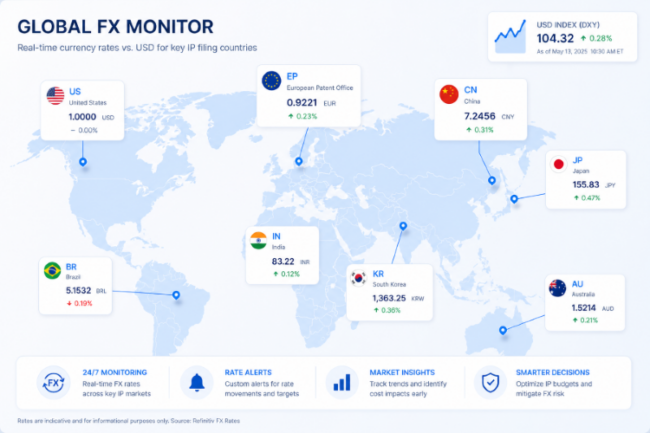
Awareness of FX as a cost driver has grown significantly over the past few years. More IP owners are asking for itemized invoices. More vendors are offering tighter caps as a selling point. And tools now exist that let you benchmark what you’re paying for currency conversion against what the market actually looks like.
That doesn’t mean the problem is solved. It means you now have options you didn’t have before.
If you haven’t reviewed your annuity contract’s FX terms recently or if you’ve never explicitly negotiated them, it’s worth doing before your next renewal cycle. The exposure is real, it’s measurable, and it’s fixable.
Need help with your annuity contract?
Reach us at support@prokurio.com
Like this kind of stuff?
Learn more about controlling IP invoice costs: IP Invoice Review
How do your fees compare?
Find out here: Fee Benchmarking