
Most Portfolios Are Bigger Than They Need to Be
That’s not a criticism. It’s a natural outcome of how IP portfolios grow. Patents get filed when products launch, when technologies develop, when legal strategy calls for broad coverage. What rarely happens with the same regularity is taking assets out.
The result, over time, is a portfolio that includes patents and trademarks nobody would file today, still generating maintenance costs, still requiring management attention, still sitting on the books because the risk of abandoning something feels worse than the cost of keeping it.
That calculus changes when budget pressure arrives. And if you wait until the budget is already cut to start thinking about pruning, you’re making decisions in a hurry with incomplete data.
The Three Questions Worth Asking About Every Asset
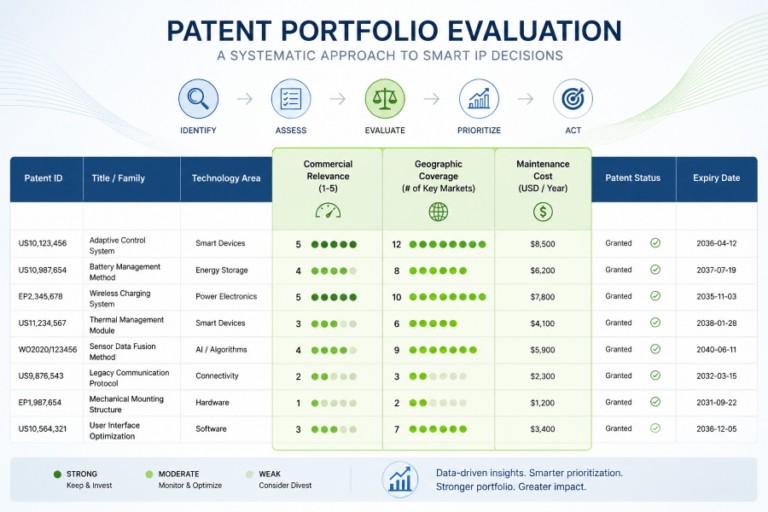
You don’t need to evaluate your entire portfolio at once. Start with the assets where the answer to any of these is already “probably not”:
Is this asset still commercially relevant? Does it cover a product or technology that your business still sells, develops, or plans to develop? Patents that were filed to protect a product line that’s been discontinued have a very different value profile than they did at filing.
Is this jurisdiction still worth protecting? Filing in 30 countries made sense when the product had global distribution. If your business has pulled out of certain markets, or if the local market doesn’t represent meaningful revenue, the protection may no longer justify the cost.
What does maintenance actually cost relative to the risk of abandoning it? Some assets are cheap to keep and expensive to lose. Others are expensive to keep and not particularly valuable to hold. These are the ones worth prioritizing in a pruning review.
Common Triggers That Make Pruning Urgent
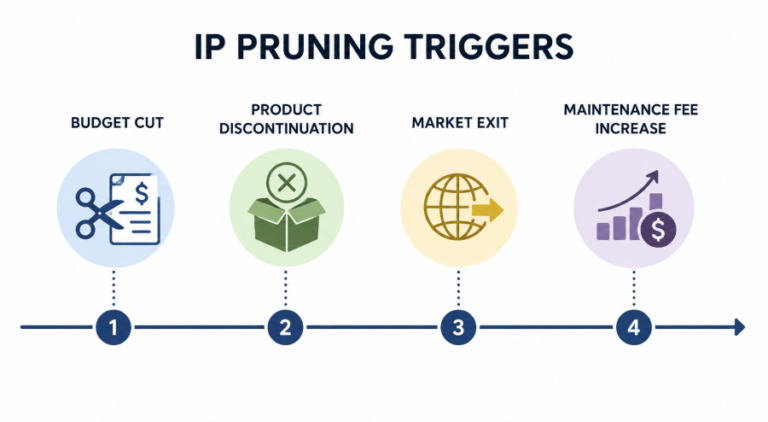
Pruning doesn’t always start as a strategic exercise. These are the situations that usually force the conversation:
- Budget cuts — Legal gets asked to reduce spend by a fixed amount, and IP maintenance is one of the levers
- Product discontinuation — A product line gets sunset, leaving its IP portfolio without a clear commercial home
- Market exit — The business withdraws from certain geographies, making local IP protection redundant
- Maintenance fee spikes — Renewal costs in specific jurisdictions increase sharply, prompting a fresh look at whether the protection is worth the new cost
Any of these is a reasonable starting point for a pruning review. The ones that result in the best outcomes are the ones done methodically, with data, before the budget conversation is already over.
How to Build a Pruning List Without Second-Guessing Yourself
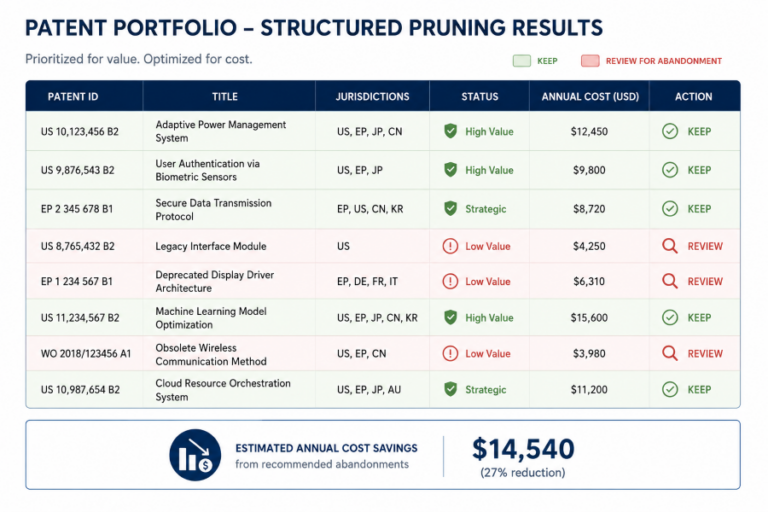
The hardest part of pruning isn’t identifying candidates — it’s making a defensible recommendation. Here’s a process that holds up:
- Start with cost, not value. Sort your portfolio by annual maintenance cost per jurisdiction. The expensive assets that aren’t obviously critical are your first review candidates.
- Apply the three questions to each candidate. Document the answers, even briefly. You’ll need this when someone asks why you’re abandoning something.
- Model the savings before you commit. If you abandon the candidates on your list, what does that actually save over 3 years? Over 5? Make sure the number justifies the process.
- Route decisions to the right people. Some abandonments are straightforward operational decisions. Others need input from the business unit or R&D. Build routing into your process so the right person signs off on each decision.
- Set a default renewal date. Don’t let the pruning review drag past the next renewal window. If a decision isn’t made in time, default to renewal rather than accidentally missing a payment.
How to Win the Pruning Conversation With Reluctant Stakeholders
IP pruning feels risky to people who aren’t close to the portfolio. “What if we need that patent someday?” is a real concern, even when the patent covers a technology nobody uses.
The most effective way to manage this is data, not persuasion. Show the maintenance cost over the remaining life. Show what the patent covers and whether it maps to current or planned products. Show the competitive landscape. Is anyone actually working in this space that the patent would matter against?
When the recommendation is grounded in specific, documented reasoning rather than general portfolio strategy, it’s much easier to get sign-off.
Why the Window Before Budget Season Matters
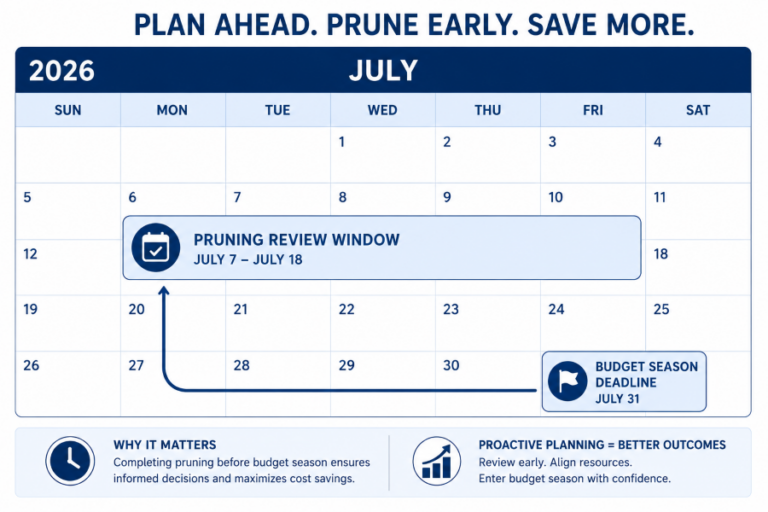
Pruning done reactively, after the budget is already set, is stressful and often results in cutting the wrong things. Pruning done three to four months before budget season gives you time to:
- Run a proper review with input from the right people
- Model the savings accurately so you know what to promise
- Avoid missed payments by completing abandonments before the next renewal cycle
- Come into budget negotiations with a plan rather than a problem
If budget season is coming up and you haven’t started this process, now is the right time. The Pruning Planner in Prokurio lets you model your maintenance cost projections, test different pruning policies, and see the savings before you commit to any decisions. It’s a good place to start.
Like this kind of stuff?
Learn more about the Pruning Planner: Meet the Pruning Planner
Want to learn more about our IP budget planning tools?
Learn more here: IP Budgeting Tools