
Having a Budget Is Not the Same as Having an Accurate One
Most IP teams have a budget. Far fewer have one they can confidently stand behind when someone starts asking specific questions about where the numbers came from.
If your IP budget was built more than a few months ago, or if it was inherited from someone who is no longer on the team, it is worth running through these ten checks before the next budget cycle or the next conversation with finance.
The Checklist
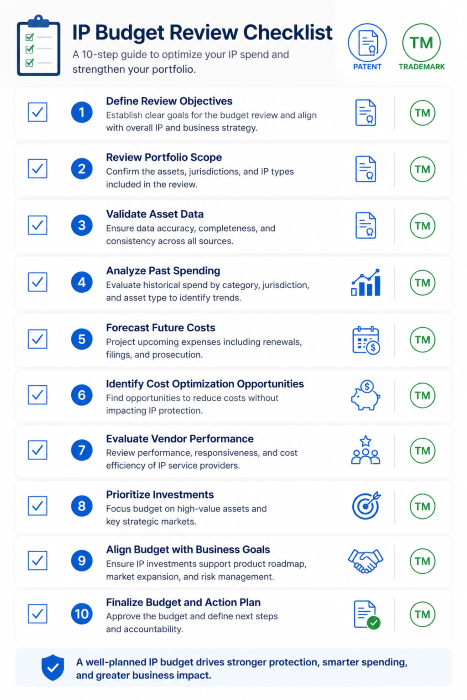
1. Is your portfolio list current?
Your budget should reflect your active portfolio and not the portfolio as it was six months ago. If patents have been abandoned, granted, or added since your last update, your cost projections are already off. Start here before anything else.
2. Are your official fee schedules up to date?
Patent offices change fees regularly. If the fee schedules in your budget reflect rates from last year or earlier, you may be significantly over or under your actual obligations. Check the current published rates for your highest-cost jurisdictions at minimum.
3. Are your foreign associate rates current?
Foreign associate fee schedules negotiated two or three years ago may no longer reflect market rates. If rates have increased and your budget has not been updated accordingly, you will run over. If you have not benchmarked recently, you may also be overpaying without knowing it.
4. Have new grants been added to the annuity schedule?
Every patent that grants enters a maintenance fee schedule, often across multiple jurisdictions simultaneously. If patents granted in the last twelve months have not been added to your cost projections, you have obligations that are not in your budget.
5. Have abandonments been removed from the cost model?
Costs for abandoned or expired patents should drop out of the model. If they have not been removed, your budget is inflated by maintenance obligations that no longer exist.
6. Are prosecution cost estimates based on current filing activity?
Prosecution costs, including office actions and examination fees, are driven by filing activity. If your estimates rely on last year’s volume instead of your current pipeline, they may overstate or understate upcoming costs.
7. Are translation costs accounted for separately?
Translation costs are often bundled into prosecution or foreign associate fees and can be overlooked. If your budget does not include a separate line for translations, verify that these costs are accounted for elsewhere and not missing entirely.
8. Are your FX assumptions documented and reasonable?
If your budget uses last year’s average exchange rates without documenting that assumption, a significant currency movement will produce a variance that is hard to explain. Document the FX assumptions explicitly and consider whether a sensitivity range is worth including.
9. Does your budget include at least two scenarios?
A single number is a point estimate, not a plan. If your budget does not include at least a base case and a growth or reduction scenario, you are not prepared for the first question leadership asks when the business direction changes.
10. Can you explain every major line item if asked?
A reliable budget should have a clear explanation behind every major cost category. If you cannot explain what is driving a cost or the assumptions behind it, that line item may need further review before the budget is finalized.
What to Do With the Results

If you worked through the checklist without identifying any major issues, your budget is likely on solid footing. If several questions revealed gaps, focus first on the areas with the greatest financial impact, such as official fees and foreign associate costs in your highest-volume jurisdictions.
A budget that passes this checklist is not only more accurate, but also easier to justify when stakeholders ask how the numbers were determined. Each major cost should be supported by clear assumptions and reliable data.
Prokurio brings portfolio data, fee schedules, and cost forecasts together in a single platform, making reviews faster and more efficient. If answering these questions requires pulling information from multiple systems, it may be time to streamline your process before the next budgeting cycle
Like this kind of stuff?
Learn more about the IP Financial Planning: IP Financial Planning
Want to see IP cost forecasting in action?
Find out here: Global IP Forecaster