The Budget Is Not the Problem. The Data Underneath It Is
When an IP budget turns out to be wrong, the diagnosis usually points to the numbers. But in most cases the root cause was the data the budget was built on. Stale fee schedules. An unreconciled portfolio list. FX assumptions nobody documented. A prosecution pipeline nobody reviewed.
Fix the data and the budget fixes itself.
The Four Data Problems That Show Up Most Often
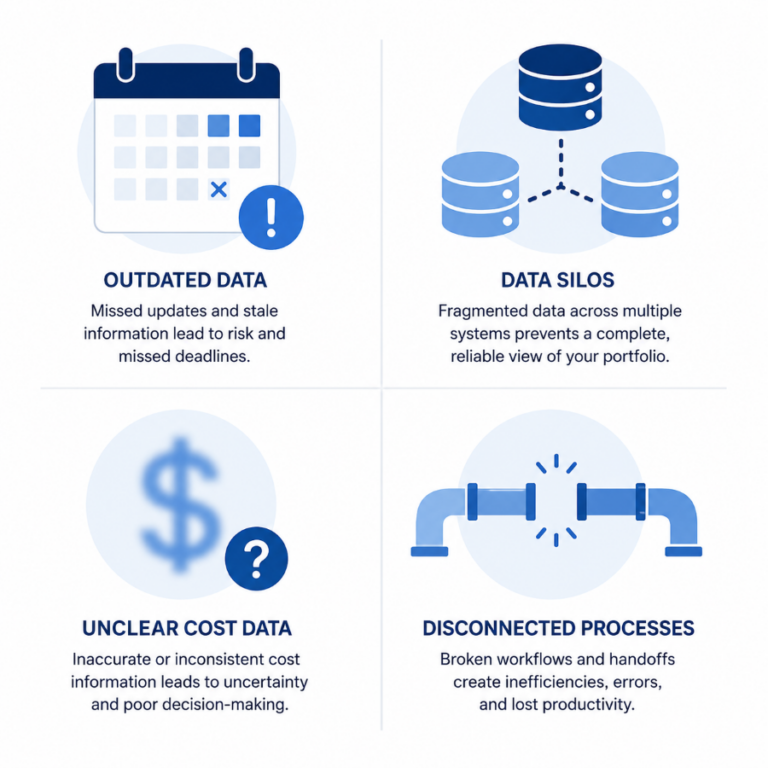
Stale fee schedules. Official fees change regularly across dozens of jurisdictions. If fee schedules have not been updated in six to twelve months, the errors compound across every payment in every affected jurisdiction.
Fragmented portfolio data. Most IP teams pull information from two or three sources that rarely agree perfectly. The budget inherits whatever inconsistency exists between them.
Undocumented FX assumptions. Every budget with foreign costs has FX assumptions embedded in it, but in most cases they are implicit. When costs come in differently than budgeted, FX is often the explanation, but nobody can prove it.
An unreviewed prosecution pipeline. Prosecution costs cluster in patterns based on when applications were filed. A cost spike from a high-filing cohort three years ago can hit the budget without warning if the pipeline has not been reviewed.
Why These Problems Persist

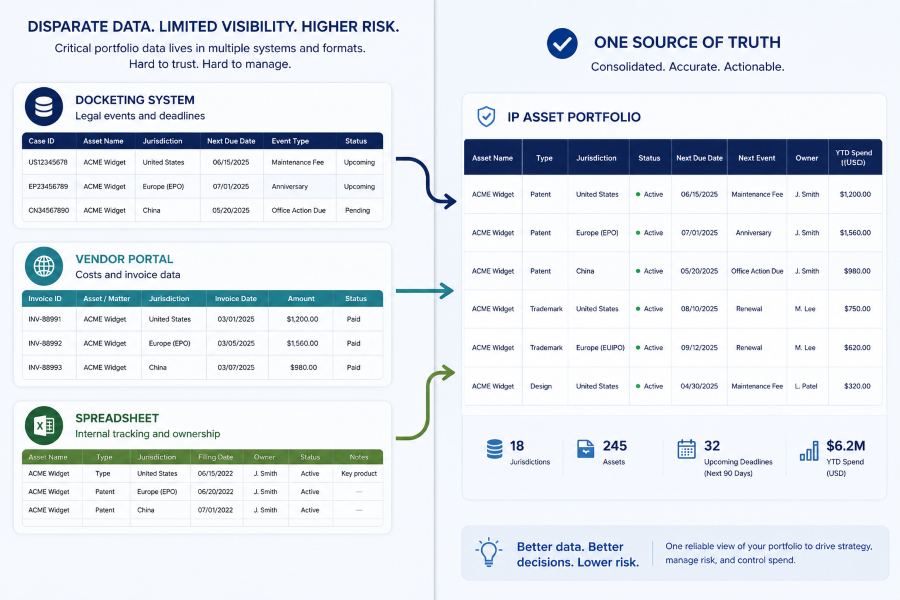
IP cost data lives in places that were not designed to talk to each other. Docketing systems track legal status. Vendor portals track payment history. Fee schedules arrive from associates in whatever format they prefer. Nobody owns the reconciliation job because it was never formally defined.
Each source is reasonably accurate on its own terms and collectively unreliable as a budget foundation.
What Fixing It Actually Looks Like
Fixing IP budget data does not require a major technology project. It requires deciding who owns the data and where it lives.
One reconciled portfolio list updated as changes happen, not before each budget cycle. Current fee schedules for every active jurisdiction, checked quarterly for high-volume markets. Documented FX assumptions noted in the model so mid-year variances can be explained. A prosecution pipeline review at least once a year, before the budget is built.
The Compounding Effect
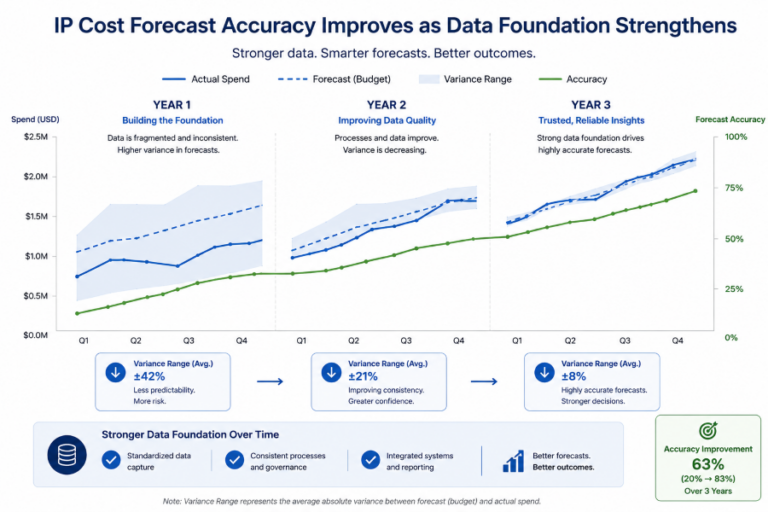
Clean data does not just produce a better budget this year. It produces a better budget every year after.
When the portfolio list is current, this year’s actuals become next year’s baseline without a reconciliation project. When fee schedules are maintained, updates flow in automatically. When FX assumptions are documented, variance analysis takes minutes.
The first year is the hardest. By year three the process is largely self-maintaining and the budget conversation is about strategy rather than data quality.
Prokurio consolidates portfolio data, fee schedules, and cost projections in one place so these problems are addressed at the infrastructure level rather than patched manually before each cycle.
Like this kind of stuff?
Learn more about the IP Financial Planning: IP Financial Planning
Want to see IP cost forecasting in action?
Find out here: Global IP Forecaster