The Financial Reality of Patent Prosecution
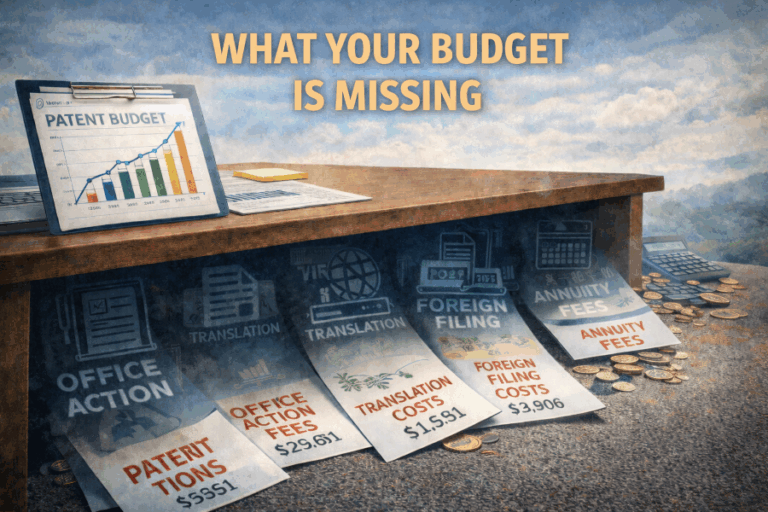
Most IP teams budget for the obvious patent costs: filing fees, attorney drafting time, and maintenance fees. But experienced practitioners know that the gap between a patent budget and actual patent spend usually lives in the prosecution phase — the back-and-forth between your team and the patent office that turns an application into a granted patent.
Prosecution costs are where forecasts break down, and where a little more visibility can save a lot of money.
For many in-house IP teams, “forecasting” means pulling up last year’s spend, adding a percentage, and hoping for the best. That approach might have worked when portfolios were smaller and fee schedules were more stable. Today, with growing global portfolios, shifting government fee structures, and increasing pressure from finance to justify every dollar, it’s no longer sufficient.
The Costs Everyone Remembers
Let’s start with what typically makes it into a patent budget. Government filing fees are published and predictable. Drafting costs, while they vary by technology and complexity, are usually scoped at the outset of an engagement. And maintenance fees follow a known schedule, you can plot them out years in advance.
These are important line items, but they’re also the easy ones. The harder costs to forecast are the ones that emerge during prosecution, often driven by examiner behavior, claim complexity, and strategic decisions your team makes along the way.
The Costs That Slip Through
Office action responses. The number of office actions an application receives is one of the biggest variables in patent prosecution cost. A straightforward application might receive one non-final rejection. A complex one might go through multiple rounds, each requiring attorney analysis, claim amendments, and sometimes interviews with the examiner. Each response can run anywhere from $2,000 to $8,000 or more, depending on complexity and the rates of outside counsel.
Restriction requirements. When an examiner determines that an application contains more than one distinct invention, they’ll issue a restriction requirement. The applicant must elect one invention to pursue and may need to file divisional applications for the rest. Each division is essentially a new application with its own prosecution path and associated costs. A single restriction can double or triple the total cost of protecting an invention.
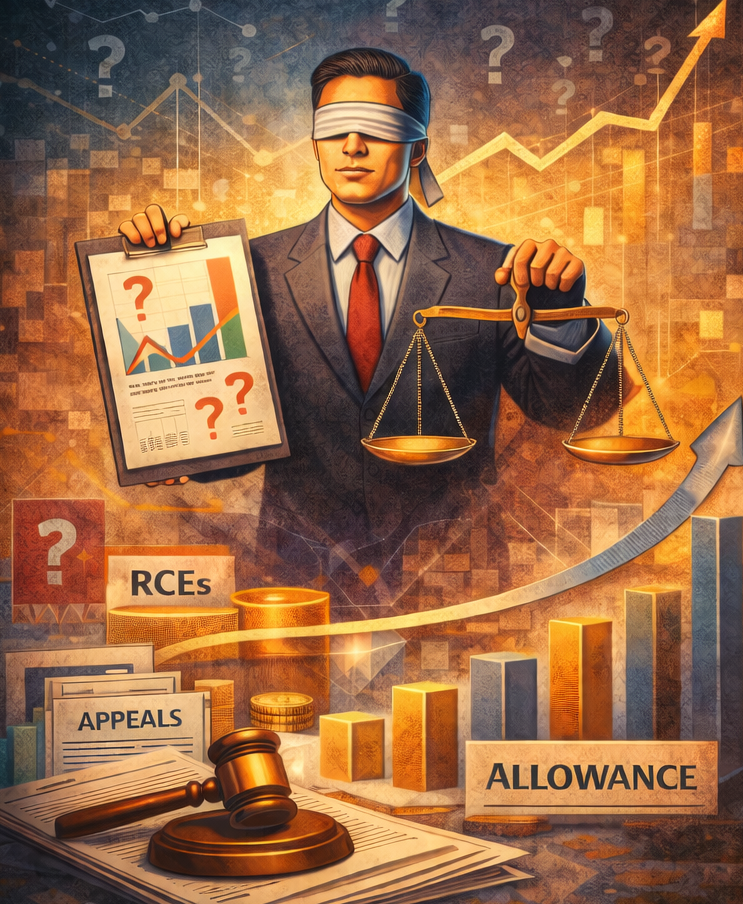
Requests for Continued Examination (RCEs). When prosecution reaches an impasse — typically after a final rejection — filing an RCE reopens prosecution. Government fees for RCEs have increased significantly in recent years, and each one adds another cycle of attorney time. Some applications accumulate two, three, or more RCEs before reaching allowance.
Appeals. If office action responses and RCEs don’t resolve the disagreement with the examiner, an appeal to the Patent Trial and Appeal Board may be necessary. Appeal briefs are time-intensive to prepare, and the process can take years. The cost of a single appeal can easily reach $15,000 to $25,000 in attorney fees alone.
Information Disclosure Statements (IDS). The duty to disclose relevant prior art continues throughout prosecution. As new references surface — from related applications, third-party searches, or foreign counterparts — IDS filings accumulate. Individually, they’re modest expenses, but across a large portfolio, they add up.
Examiner interviews. While often a smart prosecution strategy, interviews require preparation time and sometimes travel or technology coordination. They’re rarely budgeted for explicitly, yet experienced prosecutors know they can be one of the most cost-effective tools for advancing prosecution.
What Makes These Costs Challenging to Estimate in Advance?

The challenge isn’t that these costs are unknown. Any experienced patent practitioner can list them. The challenge is that they’re probabilistic. You can’t predict with certainty which applications will receive restriction requirements, how many office actions each will face, or which ones will need appeals.
What you can do is use historical data to build probability-weighted models. If you know that 30% of your applications in a given technology area historically receive restriction requirements, you can factor that into your forecast rather than being surprised when it happens.
Similarly, if your average prosecution costs two office action responses, you can build that expectation into your per-application cost model while maintaining a reserve for outliers.
A Better Approach
The most accurate patent cost forecasts don’t try to predict the exact prosecution path for each application. Instead, they model costs at a portfolio level using historical averages, known variables (like technology area and filing jurisdiction), and scenario analysis for high-uncertainty items.
This shift from per-application guessing to portfolio-level modeling is what separates IP teams that consistently hit their budgets from those that don’t.
Over the coming weeks, we’ll dig into the specific cost drivers that make patent and trademark forecasting challenging, explore frameworks for building better models, and look at how leading IP teams are approaching this problem. Whether you’re managing a portfolio of fifty assets or fifty thousand, the principles apply and the payoff is significant.
Next in our series, we turn to trademarks and explore the full lifecycle of costs from filing through renewal.