
The IP Cost Management Challenge
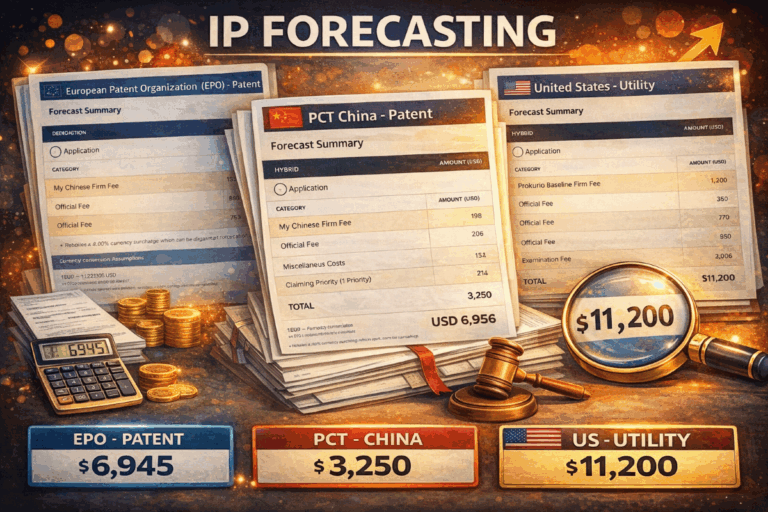
If you manage an intellectual property portfolio, you already know the costs add up fast. Filing fees, attorney hours, maintenance fees, prosecution costs, foreign associates — the list goes on. What’s less obvious is how much money organizations leave on the table by treating IP budgeting as an annual guessing exercise rather than a disciplined forecasting practice.
For many in-house IP teams, “forecasting” means pulling up last year’s spend, adding a percentage, and hoping for the best. That approach might have worked when portfolios were smaller and fee schedules were more stable. Today, with growing global portfolios, shifting government fee structures, and increasing pressure from finance to justify every dollar, it’s no longer sufficient.
The Real Cost of Poor Forecasting
Patent and trademark costs don’t behave like most corporate expenses. They’re driven by a combination of factors that can be difficult to model: the timing of office actions, the unpredictability of prosecution paths, currency fluctuations for international filings, and the variable pace at which new inventions or brands enter the pipeline.
A single patent application might cost $15,000 or $50,000, depending on the technology area, the number of office action responses required, and how many countries you file in. Multiply that uncertainty across hundreds or thousands of assets, and you can see why a simple spreadsheet falls short.
Trademarks carry their own complexity. Renewal cycles, opposition proceedings, and the expanding geographic footprint of modern brands all create cost variability that’s hard to capture without a structured approach.
What Good Forecasting Looks Like
Effective IP cost forecasting isn’t about predicting the future with perfect accuracy — it’s about building a model that accounts for known commitments, likely scenarios, and the key variables that drive cost variation. A few characteristics distinguish strong forecasting practices from weak ones.

First, good forecasts separate the predictable from the uncertain. Maintenance fees and renewal deadlines are well-known in advance. Prosecution costs and new filing volumes are less certain but can be estimated using historical patterns and pipeline data.
Second, strong forecasts are living documents. They get updated as new information comes in, when an examiner issues a restriction requirement, when a new product launch adds trademark filings, or when exchange rates shift significantly. Annual budgets set the frame, but quarterly or even monthly refreshes keep the picture accurate.
Third, the best forecasting practices connect cost data to strategic decisions. They don’t just answer “how much will we spend?” They help answer “where should we spend, and what’s the return?”
The Opportunity Ahead
In-house IP teams that invest in better forecasting gain more than budget accuracy. They gain credibility with finance and leadership, the ability to make proactive portfolio decisions instead of reactive ones, and a clearer connection between IP spending and business value.
Over the coming weeks, we’ll dig into the specific cost drivers that make patent and trademark forecasting challenging, explore frameworks for building better models, and look at how leading IP teams are approaching this problem. Whether you’re managing a portfolio of fifty assets or fifty thousand, the principles apply and the payoff is significant.